Sunday, 29 November 2009

upcoming: Pictures Reframed a performance by Leif Ove Andsnes & Robin Rhode


Pictures Reframed - is a collaborative performance from pianist Leif Ove Andsnes and visual artist Rhobin Rhode which centers around Mussorgsky's piano suite Picutres at an Exhibition


Robin Rhode: is a performance artist who grew up in Johannesburg. He creates energetic narrative performances that evolve around his drawings he uses the street, and in his later work gallery walls as his canvas. The documentation is often in photographic storyboard sequences or animations, Rhode transform his flat drawings of everyday objects into three-dimensional ones through his playful physical interaction. The simplicity of the medium, body chalk and surface is refreshingly unfussy, and the work has a sense of humour and play while often referencing political issues.

Friday 4th December @ the Southbank Centre
1st performance 7:30pm, 2nd performance 9:30pm
(2nd is a more informal presentation of the performance, and a panel discussion between with Robin Rhode, Southbank Centre's Head of Contemporary Culture Gillian Moore and Southbank Centre's Chief Curator of the Hayward Gallery Stephanie Rosenthal)

I'm going to the 9:30 one if anyone want's to come along please do
there are limited concession prices at £4.50 otherwise the next cheapest bracket is £9

articles and findings related to Open Sailing


under water sports - randomly saw on ffffound.com

Online article "Buildings that eat carbon dioxide? Fish becteria that light the streets? Meet the architects rebuilding our future"
Hannah Devlin, October 8 2009, Living in the city, Times Online

"Dr Rachel Armstrong, an architectural researcher from University College London"...."Leave a fish rotting in a bowl of water for long enough and it will begin to glow. The light comes from bacteria in the fish. Vibrio phosphoreum, allows the fish to glow and flicker in the deep ocean. The flashlight fish carries the bacteria in pouches beneath its eyes, which it opens to show off the glimmering organisms or closes to hide them, depending on whether it wishes to lure in prey or evade predators."

"With her colleagues at the Bartlett School of Architecture, Armstrong is focusing on: technologies that are cheap and relatively simple." "One possibility is the use of bioluminescent bacteria, organisms that give off a blue-green glow, as low-energy urban lighting. In the US, urban lighting accounts for more than 8 per cent of the country’s total electricity consumption." This produces light automatically when a pigment contained in the bacteria called luciferin, from the Latin meaning light bringer, reacts with oxygen in air or water. At present, the light emitted is not strong enough to illuminate a street, but scientists believe that it could be engineered to do so. Another possibility is using bacteria to metabolise carbon dioxide through photosynthesis so that the bacterial coating would effectively eat up carbon dioxide by turning sunlight into energy."

"...according to Armstrong, scientists have already identified numerous common species that carry out these functions. She is now looking at the possibility of using cyanobacteria, also known as blue-green algae, to capture carbon dioxide."....."Armstrong views this challenge as a form of gardening. “Bacterial gardens don’t really exist and that’s what we need to create,” she says."

Scientist research into artificially speeding the process of limestone formation, atmospheric carbon dioxide is transformed in a solid carbonate form. "The carbon choking our planet could become a harmless decorative feature." which could be scraped of and reuse it as a building material. Armstrong envisages using this to create facades which "would look like Narnia under the White Witch."

Canadian architect Philip Beesley and Armstrong are presenting a joint exhibition about the technology at the UN climate change conference in Copenhagen in December.

more information at:

Friday, 27 November 2009

Bear Chair


I think this is amazing
However it does seem to have 6 paws

Stephen Knott


While researching for my Dissertation I found this blog he has written some quiet interesting stuff.

Stephen Knott, He is currently reserching at the RCA and for the V&A. He has commented on the Radical Nature exhibition that we all went to. He has also got some interesting work up about streets and work done in the street.

http://knotthistory.co.uk/

Upcoming panel discussion: Reconsidering Urban Landscape

Wednesday 2 December,(also Tom's Birthday) 7-9pm
Gasworks residency artist Allard van Hoorn will host a panel discussion on how art in the public space can provoke a new experience of the urban landscape. He will be joined in conversation by artists Jose-Arnaud Bello, Shezad Dawood, Theo Lorenz and Richard Wentworth.

Allard van Hoorn uses architecture, music, design, dance, sculpture, installation and writing to conduct his research into urban environments. Often working in collaboration, his interventions in public space investigates our understanding of the various urban terrains we pass through and inhabit.


2008, Matchmaker, a project for Savador de Bahia & Shanghai

During his residency at Gasworks, Hoorn is developing 'Urban Songlines London', a mapping research project of urban spaces. Inspired by Aboriginal Australians tradition of Songlines(a system for navigation and caretaking on the land), he transfers the spiritual understanding of place to London's architecture and urban structures. Through this Hoorn explores how we use and experience public spaces, forming a link between the performer, audience and site, he creates a method of claiming back privatised urban spaces.

Gasworks,155 Vauxhall Street, London SE11 5RH

I'll be going if anyone wants to come with me, please do.
Also the Do you remember Olive Morris exhibition is on at Gasworks, so I'm going to go a bit before to look at this.

Thursday, 26 November 2009

In responce to Tims Post...

Great quote Michael Marriott showed me on placement. TEN
Designhttp://ten-xyz.com/?page_id=4
http://tenproject.wordpress.com/

"What will happen to design in the coming years? What will be the aims of product design? What will design mean and how will it be evaluated? A rethink is urgent, yet has hardly even begun. With our technological-industrial civilization threatening to destroy life on Earth, far reaching changes are inevitable. We can only hope that these changes will come about through our own conscious efforts, and will not be forced upon us by catastrophe. Perhaps they will lead not to an improvement of our lives but to enrichment."
- Dieter Rams
- 1999

Quite Nice

Wednesday, 25 November 2009

Developement of the Boat using the modular system

This a sketchup of how the Boat looks using the modular system. The central mast can be used to put up a shelter and to attach a sail when we want to move, The addition of moveable rudders gives us more maneuverability in the water; this plus the addition of multiple sails gives even more ability to navigate. The ballast is retractable for navigation as well. One of the highest priorities in the design is the ability to escape the vessel if it capsizes. We have a number of ideas on this in development that can be utilised using this system.

001shelter 002navigate

More flexible version, not hard floor, just modules, large double ballasts. By Cesar Harada & Owen Hodgkinson

http://international-ocean-station.org/download/20091125mast-ropes-rudders~.skp
http://international-ocean-station.org/download/20091124stack-side.skp

See the full progression, from the original idea to where we are now here:

http://sites.google.com/a/opensailing.net/www/labs/instinctive_architecture/shelter

Tuesday, 24 November 2009

More Idea development

We are getting close!


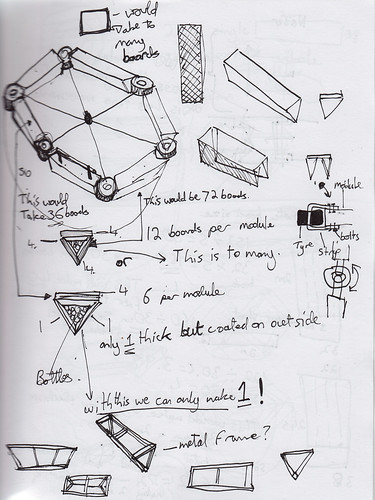
Modules showing their ballast bags


Untitled-5

Some variations in the module design: different use of tyres


Untitled-4

A central mast allows us to create a much more stable structure making everything tensile with the use of cables

Untitled-1

The Umbbrella! we are heading in a good direction. Next we are building a google sketchup model to show more clearly our design. The system is completely modular and very economical as it has very few components: floatation boards made of layers of plywood and foam board coated in fiberglass. Tyres, cables, materials for masts.

More coming soon. Checkout the updates on the site: http://sites.google.com/a/opensailing.net/www/labs/nomadic_ecosystem/drafts-ideas

This is a google sketchup of or idea so far. We are working on the design for the mast and having adjustable hulls that can fit in multiple places. We can also have multiple sails on this structure allowing for better navigation. Coming soon...

20091124stack-side

Sunday, 22 November 2009

Meeting Dieter


As some of you know an exhibition of the work of Dieter Rams has just opened at The Design Museum in London. You may remember Rams from film clips I’ve shown you in the lecture programme. He was the son of a cabinet maker who went on to work for Braun in Germany, creating many iconic products that were the main influence behind Jonathan Ive’s recent work for Apple Computers. His work is often described as minimalist but he also made some major contributions in terms of ideas. He was the first to put a Perspex top on a record player and to design hi-fi’s with detachable speakers. His TP1 record player was portable and could be used with headphones, pre-dating the Sony Walkman by exactly 20 years.

I met Dieter Rams at the RSA (to give it the full title, The Royal Society for the Encouragement of Arts, Manufactures and Commerce) on Thursday night. The RSA has, since 1936, given awards for excellence in design by inaugurating designers into their Faculty of Royal Designers. For the past year I have been helping one of the Royal Designers, ceramics designer Robin Levien to prepare the lecture that he delivered on Thursday night. The lecture was entitled Elusive Rightness in Design and will soon be available to view on the RSA’s site. Dieter Rams was there as a guest and I got the chance to have a brief chat after the lecture. He urged me to pass on this advice to students (something I hope we have already told you!) – experience with materials is the most important thing in design – to be placed above experience with computers. Yet this was not said from a nostalgic, backward-looking perspective. He said that he was the first to introduce computers into the model shop at Braun, but has resisted using them himself during the design process because they take you out of touch with the real attributes of the object and its materials.

While we are in the process of trying to extend the opportunities for using CAD at Camberwell, as Rams reminded me, it is, of course, a tool like any other. Choosing the right tool at the right time is key to becoming a skilled practitioner. It's interesting that someone like Rams who has spent his life designing machines for mass production should be so sensitive towards the role of craftsmanship in the design process.

Less and More – The Design Ethos of Dieter Rams is on at The Design Museum until 7th March 2010

Rams is interviewed on the BBC’s Culture Show on Thursday 3rd December at 7pm on BBC2

Listen to Justin Mcguirk from Icon Magazine and Sam Hecht from Industrial Facility talking about Rams on Radio Three's Nightwaves programme. (note - start from 23 minutes 35 seconds into the programme)

Balance Testing

The following video shows some very scientific high-tech tests testing turbulence on the floating garden modules to determine their dimensions:


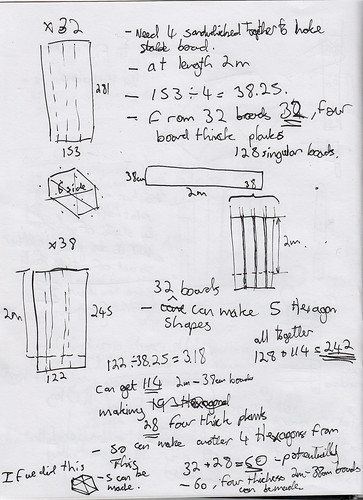
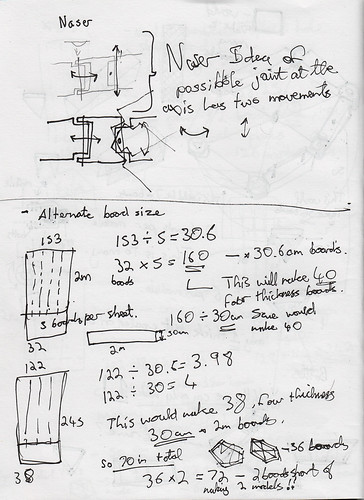
Here are the measurements for the individual pieces that will make up the floating garden modules. They are calculated based on the amount of plywood we have available.

Untitled-1Untitled-2Untitled-3Untitled-4

Using three sheets of plywood with two pieces of foam insulation board sandwiched in between will give enough buoyancy for the floating garden to float. From the calculations this will allow us to make a number of floating gardens allowing us to test variables by making each floating garden different

Module size testing

We are trying to determine the module size we need to be able to withstand the turbulence at sea and to be stable enough for us to walk on.

The module has to:
-Use the material limitations we have economically
-Have enough buoyancy to allow two people to float on it
-Able to walk along it comfortably
-Have enough room for added safety equipment/space to transport harvested food
-To be used as individual life rafts if the gardens break
-Be able to fit into the size of transport we have (a van)

The following are some practical investigations into sizes of possible modules:

The first test was a test of balance, being able move around freely in turbulent conditions is one of the highest priorities and will determine the size of the module


Open_sailing balance test

The optimum width we found was 60cm across

Open_sailing balance test

A length of 240cm we found to be long enough for us and some equipment

Open_sailing balance test

Lastly if we break the module is long enough to be used as a raft

IMG_0560 IMG_0561 IMG_0562

-So a module length of 240cm x 60cm will be used

module size


Saturday, 21 November 2009

Tom's Direction

Direction at the moment - Self powered contraptions. And local wood another - potential of focusing on making in the home environment? - e.g processing the raw material from its natural form using techniques that could theoretically be done at home? All still a bit vague at the moment.

Rendering of simple idea - an long the lines of self power.

Research of how to process logs into lumber without the use of a saw mill

Friday, 20 November 2009

Week 1: Design


Initial Design Sketches


From initial research by Cesar it was found that the two most stable shapes in water are a sphere and a pole. This because the surface in contact with the water does not change much with both shapes therefore they don't experience much turbulance. This is why most buoys are a combination of these two shapes.


The next research influenced the shape.
From studying different life rafts for
survival at sea Cesar found that the best
life raft available was the 'Givens Life Raft'
Below is a video of it in use. Cesar was able
to go inside one of these raft to see first-
hand what they are like


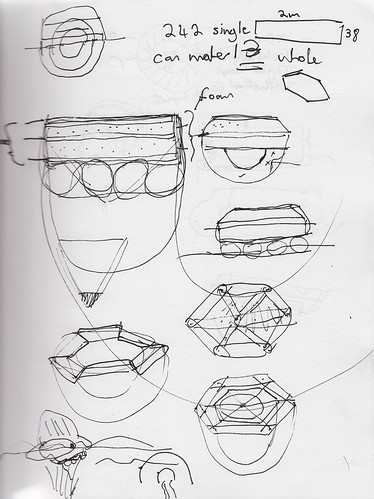
This is a slideshow of some draft sketches of the floating gardens development


Week 1: Research

Some images from research


The rest of the images are on my flickr account/or the open-sailing website:

-http://www.flickr.com/photos/owenhodgkinson/
-http://sites.google.com/a/opensailing.net/www/labs/nomadic_ecosystem/exisiting-aquaculture-techniques/fish-aquaculture

Week 1

Framework

-What we want to do?
We want to live at sea. To do this we need food and water. These are the first things we will be looking at. We hope to build a prototype for a floating garden that we can use to provide us food from the ocean.
-Research
The Imperial College Library has a large collection of specific books in a lot of subject areas. Along with Cesar Harada we will be researching ways of harvesting food from the sea. There are numerous books on aquaculture and on harvesting and catching sea life.
The Geographical Society is also near on Exhibition Road. We are going there to investigate the site we will be testing our prototype at sea
The last place we will research in is the RCA depending on Access.
-Design
In the second part of the week we will be brainstorming ideas for the floating garden; using the information we have obtained from our research to inform us on our ideas.
Then on Sunday the 15th November I will be going to Paris to continue my placement where the design and fabrication will be completed with the aim of testing what is made at sea.

Thursday, 12 November 2009

Owen Hodgkinson: Work placement

Floating gardens development

http://sites.google.com/a/opensailing.net/www/

Cesar Harada & Owen Hodgkinson, Open_Sailing November 2009 London, Paris.

== ABSTRACT ==

Open_Sailing is developing "nomadic_ecosytem", as a part of its vital modules for the International_Ocean_Station_1 prototype.
In this article we are trying to design floating gardens in order to sustain the life of the International_Ocean_Station_1 navigators for an non-determined period of time in semi-autonomy.
We have divided this fraction of research in 3 weeks :
- week 1 : human physiological need assessment, ocean capacities and overfishing alternatives, theoretical exploration of existing aquaculture models - design of several permaculture aquaculture modules suitable for the high-seas. We are trying to gather all techniques that we could use later in our design proposal, the floating garden being a modular polyvalent platform for different experiences.
- week 2 : assessment of fabrication capacities on site, fabrication of small scale model, test in the water, re-design, re-fabrication of small prototypes, selection of one for production, optimization
- week 3 : fabrication of the best prototype, test in the high sea (real conditions, french Britanny), reporting.

- week 1 : human physiological need assessment, ocean capacities and overfishing alternatives, theoretical exploration of existing aquaculture models - design of several permaculture aquaculture modules suitable for the high-seas. We are trying to gather all techniques that we could use later in our design proposal, the floating garden being a modular polyvalent platform for different experiences.

- week 2 : assessment of fabrication capacities on site, fabrication of small scale model, test in the water, re-design, re-fabrication of small prototypes, selection of one for production, optimization

- week 3 : fabrication of the selected prototype, test at sea (real conditions, french Britanny), reporting.

This can be found at: http://sites.google.com/a/opensailing.net/www/labs/nomadic_ecosystem